
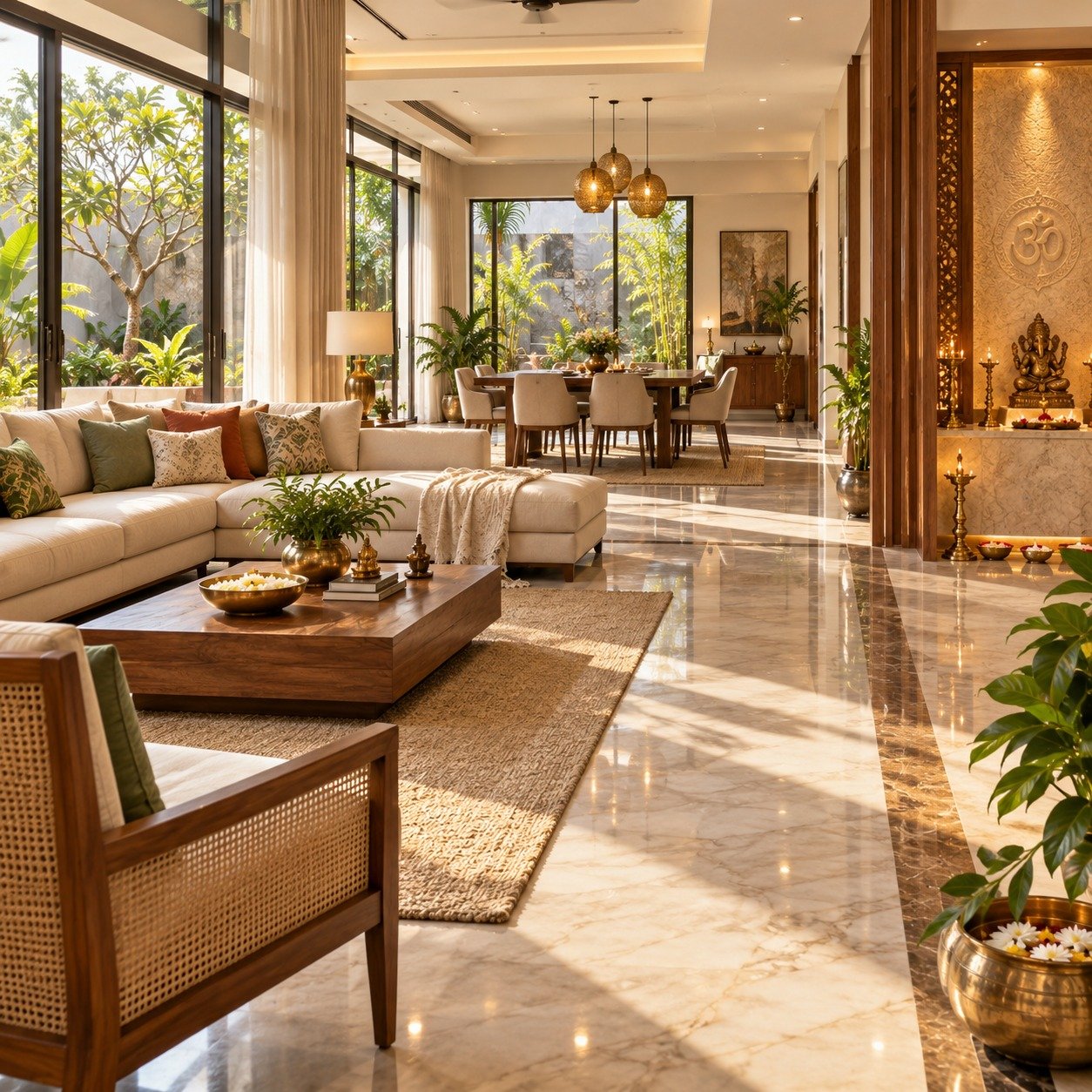
When planning or buying a house, most people think about location, budget, design, construction quality and convenience. But there is another traditional consideration that has remained relevant in Indian homes for centuries: why Vastu is important for home.
Vastu Shastra is an ancient Indian approach to understanding the relationship between people, buildings, directions, natural elements and the surrounding environment. The Indira Gandhi National Centre for the Arts (IGNCA) describes Vastu as a traditional Indian knowledge system concerned with areas ranging from site selection and construction to interior arrangement.
For a modern homeowner, Vastu does not have to mean complicated rules or expensive structural changes. It can instead encourage greater awareness of how a home is planned, organised and used.
What Is Vastu Shastra and Why Does It Matter for a Home?
Vastu Shastra is traditionally associated with Indian architecture and spatial planning. Its principles consider factors such as direction, proportions, placement, natural elements and the relationship between a building and its surroundings.
Ancient Indian architectural traditions did not view a house simply as a collection of rooms. The planning of space, movement, light, air and the relationship with nature were also important considerations.
This broader perspective helps explain why Vastu is important for home even today.
A well-planned home should not only look beautiful. It should also be comfortable, functional and suitable for the people living in it.
1. Vastu Encourages Thoughtful Space Planning
One of the most practical reasons why Vastu is important for home is that it encourages homeowners to think carefully about how different areas are positioned and used.
For example, the entrance, kitchen, bedrooms, living area, पूजा space and study or work area can each have a specific purpose. Vastu encourages us to consider these functions while planning the overall space.
This does not mean every house must follow exactly the same layout. Apartments, independent houses and modern urban homes have different limitations.
The goal should be to understand the principles and apply them sensibly.
2. Vastu Connects the Home With Natural Elements
Traditional Vastu places importance on the relationship between the built environment and natural elements.
Direction, sunlight, air movement, open space and the use of different areas are part of this traditional understanding.
Interestingly, modern building guidance also recognises the practical importance of daylight and ventilation. The Bureau of Energy Efficiency’s Eco Niwas Samhita includes provisions intended to support adequate natural ventilation and daylighting potential in residential buildings.
This gives homeowners a useful perspective: regardless of how one approaches Vastu spiritually, natural light, fresh air and sensible space planning are valuable aspects of a comfortable home.
3. Vastu Can Encourage a More Organised Home
A home filled with unnecessary clutter can become difficult to maintain and use comfortably.
Vastu discussions often encourage keeping spaces clean, organised and purposeful. This can be applied without making major structural changes.
Start with simple habits:
- Keep entrances clear.
- Avoid unnecessary accumulation of broken objects.
- Keep frequently used areas organised.
- Allow natural light wherever practical.
- Make rooms functional rather than overcrowded.
- Keep important household items in designated places.
These are simple practices, but they can make a home feel more comfortable and manageable.
4. Vastu Can Be Considered Before Buying or Building a House
Vastu can be particularly useful before a property is purchased or construction begins.
The plot, orientation, surrounding roads, entrance possibilities, room placement and available open space can be considered at the planning stage.
This is generally more practical than discovering a concern after construction has already been completed.
However, homeowners should avoid making property decisions based only on fear or rigid rules. Location, structural quality, legal approvals, construction standards, budget and practical requirements should remain important considerations.
For those interested in the traditional side of Indian spatial planning, the IGNCA’s resources on Vastu Shastra provide useful background on its history, concepts and relevance in the modern era.
5. Vastu Does Not Always Mean Demolition
One of the biggest misconceptions about home Vastu is that every Vastu concern requires breaking walls or rebuilding rooms.
That is not necessarily the case.
Many situations can first be approached through changes in space usage, furniture placement, organisation, colours, lighting and other non-structural measures.
This is particularly relevant for people living in apartments, rented properties or already-constructed homes.
If you are interested in this approach, our article 7 Powerful Benefits of Choosing a No Demolition Vastu Expert explains how Vastu assessment can focus on practical remedies without immediately recommending major reconstruction.
The right approach should be proportionate to the actual situation.
6. Vastu Can Help You Become More Aware of Your Living Environment
A home influences everyday routines.
Where you sleep, study, work, eat, relax and spend time with family can affect how you experience the space.
This is another useful way to understand why Vastu is important for home. Rather than treating Vastu as a collection of isolated rules, homeowners can use it as a framework for becoming more conscious of their surroundings.
For example, someone working from home may benefit from having a dedicated and organised work area instead of working from an uncomfortable corner surrounded by household clutter.
Similarly, a family may find that improving storage and circulation makes their living space easier to use.
These practical improvements can be valuable irrespective of one’s personal beliefs about Vastu.
7. Vastu Can Complement a Holistic Approach to Home and Life
Traditional Vedic knowledge often looks at different aspects of life as interconnected.
Vastu focuses on the environment, while Vedic astrology looks at an individual’s birth chart and planetary cycles. When used thoughtfully, these traditions can provide different perspectives rather than replacing practical decision-making.
If you are new to Vedic astrology, you can read Vedic Astrology Meaning: 7 Powerful Insights Every Beginner Should Know to understand the basic concepts before exploring how astrology and Vastu are sometimes considered together.
For individuals interested in personal timing and life cycles, How to Check My Dasha Cycle: 7 Powerful Ways to Understand It provides a beginner-friendly introduction to the concept of Dasha.
The important point is to approach these traditions as guidance and reflection, while continuing to use practical judgement.
How Can You Apply Vastu in a Modern Indian Home?
You do not necessarily need to redesign your entire house.
A sensible starting point is to observe your home.
Ask yourself:
- Is the entrance clean and welcoming?
- Are important rooms being used for their intended purpose?
- Does the house receive adequate natural light?
- Is there reasonable airflow?
- Are rooms overcrowded with furniture?
- Is unnecessary clutter accumulating?
- Is your work-from-home area organised?
- Are there practical issues that need attention?
Modern housing guidance also highlights the importance of designing openings and windows to encourage cross-ventilation and improve indoor comfort.
Vastu can be considered alongside such practical principles rather than separately from them.
Is Vastu Scientifically Proven?
This is an important question.
Vastu Shastra is a traditional Indian knowledge system with a long architectural and cultural history. Government cultural resources such as IGNCA document its textual tradition and its relevance to residential architecture.
However, individual claims that particular Vastu arrangements will automatically produce wealth, health, relationships or other specific outcomes should not be treated as scientifically established facts.
A balanced approach is therefore useful: appreciate Vastu as a traditional framework for thinking about space while also considering architecture, engineering, ventilation, lighting, safety and the practical needs of the household.
Frequently Asked Questions About Why Vastu Is Important for Home
Why is Vastu important for home?
Vastu is important to many homeowners because it provides a traditional framework for considering directions, space planning, natural elements and the relationship between people and their environment.
Is Vastu necessary for every house?
There is no universal requirement that every home must follow Vastu. Homeowners can consider its principles according to their beliefs, preferences, property conditions and practical needs.
Can Vastu be applied to an already-built house?
Yes. Vastu assessment can consider an existing home’s layout and usage. Many practical remedies can focus on organisation, furniture placement and space utilisation rather than reconstruction.
Does Vastu require demolition?
Not necessarily. Some Vastu concerns may be addressed through non-structural changes. Whether any structural modification is appropriate depends on the property and the specific concern.
Is Vastu only about directions?
No. Traditional Vastu encompasses broader ideas relating to site selection, architecture, proportions, directions, natural elements and the relationship between built spaces and their surroundings. IGNCA’s Vastu material covers residential architecture as well as concepts such as environment, directions and modern relevance.
When should I consult a Vastu expert?
Ideally, Vastu can be considered before buying a plot, purchasing or designing a house, or starting construction. However, an assessment can also be useful for an existing home when you want to understand its layout and explore practical improvements.
Final Thoughts
Understanding why Vastu is important for home does not require following every rule blindly.
The more useful approach is to understand the traditional principles, consider the actual conditions of your property and combine Vastu awareness with sensible architecture and everyday practicality.
A home should ultimately support the people who live in it. Good planning, natural light, ventilation, organisation, comfort and thoughtful use of space can all contribute to a better living environment.
For personalised guidance, Pradeep Bhanot’s The Cosmic Voice offers Vastu consultation based on traditional Vedic principles with a practical approach suited to modern homes. The objective is to understand the individual property and recommend relevant measures rather than relying on fear-based or one-size-fits-all advice.