
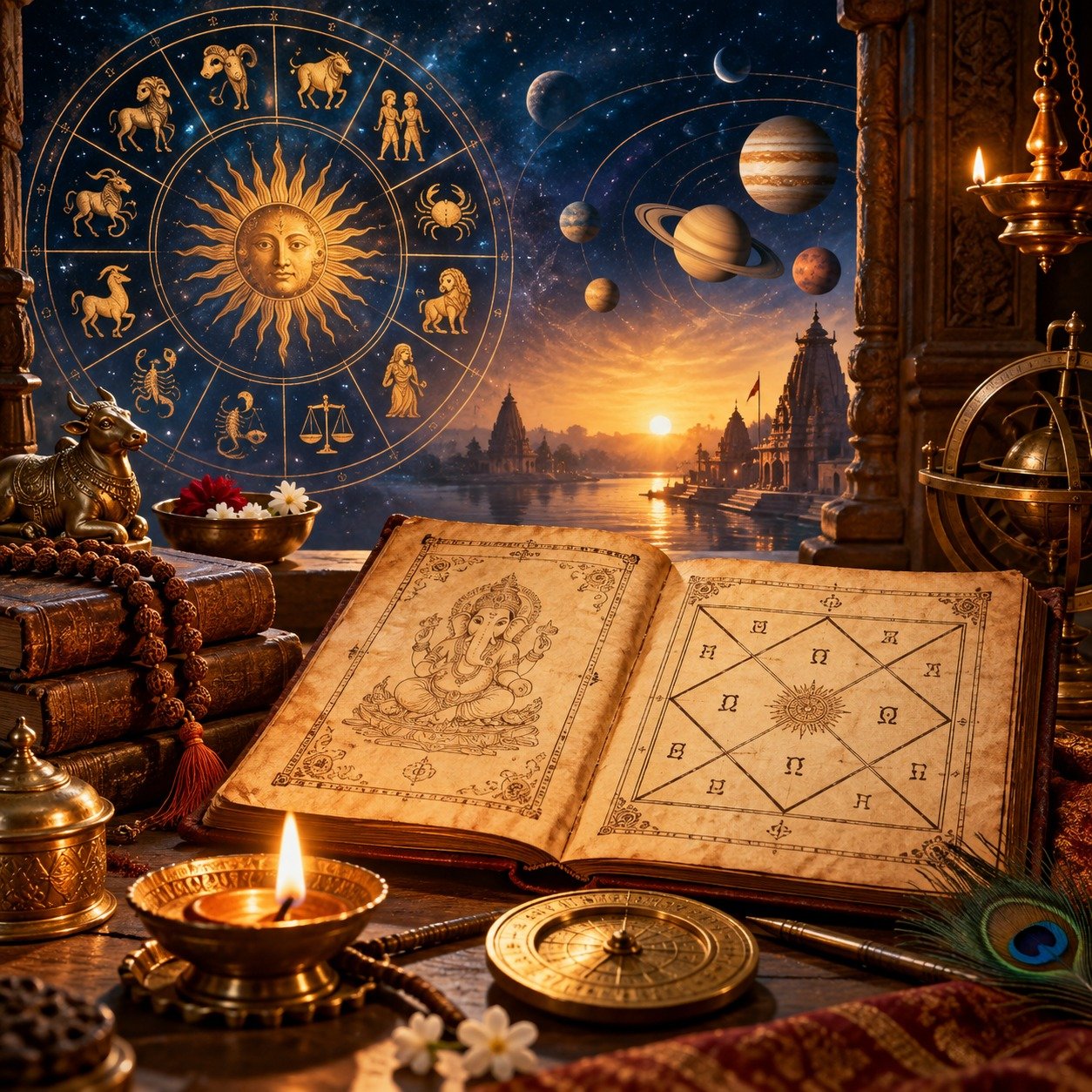
If you have ever wondered about the Vedic Astrology meaning, you may have noticed that the subject is often presented either as a way to predict the future or as something mysterious and difficult to understand. In reality, Vedic astrology has a much broader place in the Indian knowledge tradition. Traditionally known as Jyotisha, it developed alongside India’s long-standing study of time, celestial movements, calendars and human life.
For a modern Indian reader, understanding the Vedic Astrology meaning does not have to involve complicated Sanskrit terms or technical calculations. At its simplest, Vedic astrology can be understood as a traditional system that uses astronomical positions and a person’s birth details to create and interpret a horoscope for guidance and self-understanding.
The Government of India’s Vedic Heritage Portal identifies Jyotisha as one of the six Vedangas and explains its traditional connection with the observation of heavenly bodies and the calculation of time.
What Is the Vedic Astrology Meaning?
The Vedic Astrology meaning can be understood through the Sanskrit term Jyotisha, which is traditionally associated with light and celestial knowledge.
In its early context, Jyotisha was closely connected with understanding time and determining appropriate timings for Vedic rituals. Over time, Indian traditions of astronomy, calendrical calculation and astrology developed through different texts and scholarly traditions.
The important point is that Vedic astrology is not simply about predicting what will happen tomorrow.
A horoscope can instead be viewed as a traditional framework for understanding tendencies, timing and different areas of life. This makes astrology more useful when it encourages reflection and informed decision-making rather than fear.
The Government of India’s Vedic Heritage Portal notes that Jyotisha was concerned with knowledge of heavenly bodies necessary for fixing the days and hours of Vedic sacrifices.
1. Vedic Astrology Has Deep Roots in Indian Knowledge Traditions
One reason the meaning of Vedic astrology is important to understand is its connection with India’s wider intellectual and cultural history.
Jyotisha is listed among the six Vedangas, traditionally described as auxiliary disciplines associated with the Vedic tradition. The Vedic Heritage Portal explains that these six Vedangas include phonetics, ritual, grammar, etymology, metre and Jyotisha.
The Government of India’s Ministry of Culture also describes the Vedic Heritage Portal as a project dedicated to preserving and communicating knowledge associated with the Vedas and allied traditions.
This historical background helps explain why astrology has remained part of Indian cultural life for centuries.
It also reminds us that the tradition is broader than the daily horoscope found in newspapers or social media.
2. Vedic Astrology Uses Birth Details to Create a Horoscope
A major part of understanding Vedic Astrology meaning is knowing what a horoscope actually represents.
In a Vedic astrology consultation, birth information such as the date, time and place of birth is used to calculate a horoscope. The resulting chart represents the positions of celestial bodies according to the chosen astrological system at the time of birth.
The chart is then interpreted through traditional principles.
For example, an astrologer may examine areas associated with:
- Career and professional direction
- Marriage and relationships
- Education
- Family life
- Financial matters
- Personal development
- Important periods of change
- Spiritual interests
This is why a personalised horoscope reading can be very different from a generic zodiac-sign prediction.
Two people may have the same Sun sign but very different birth charts and life circumstances.
3. Vedic Astrology Is More Than a Prediction System
Perhaps one of the biggest misconceptions about Vedic astrology is that its only purpose is to tell people exactly what will happen in the future.
A more responsible approach is to use astrology as a guidance and reflection tool.
For example, someone considering a career change may use a horoscope consultation to explore traditional astrological perspectives about timing and personal tendencies. However, the final decision should also consider skills, finances, responsibilities, opportunities and practical circumstances.
Similarly, someone considering marriage may seek marriage astrology guidance while also considering compatibility, communication, values and mutual understanding.
This approach keeps astrology relevant without presenting it as a replacement for personal responsibility.
If you are interested in the broader connection between traditional guidance and the spaces in which we live, you can also read 7 Powerful Ways Your Home Environment Can Influence Your Mind and Decisions. The article explores how surroundings can affect everyday comfort, focus and decision-making.
4. Vedic Astrology and Astronomy Have an Important Historical Connection
Another important part of the Vedic Astrology meaning is understanding the historical relationship between celestial observation and Indian astronomy.
Ancient Indian scholars developed detailed traditions for observing and calculating celestial movements. India’s scientific heritage includes major contributions to mathematical astronomy by scholars such as Aryabhata, Varahamihira and Bhaskara.
The Government of India’s India Science Heritage portal describes Indian astronomical traditions involving the Sun, Moon, nakshatras, planets, calendars and mathematical calculations.
The same portal notes Varahamihira’s contributions to mathematical astronomy and his work on astrology.
It is important, however, not to treat modern astronomy and traditional astrology as identical disciplines. Modern astronomy is an empirical physical science, whereas Vedic astrology belongs to a traditional interpretive system.
Understanding this distinction makes the subject easier to approach without unnecessary confusion.
5. Nakshatras Have an Important Place in Vedic Astrology
If you have heard terms such as Nakshatra, Rashi or Janma Kundli, you have already encountered important parts of Indian astrological tradition.
Nakshatras are traditionally associated with divisions along the Moon’s path. They have played an important role in Indian calendrical and astrological traditions.
The Indian National Science Academy’s National Digital Library resource includes historical research on the origins and development of nakshatras in early Indian astronomy and astrology.
For someone learning Vedic Astrology meaning, the simplest way to understand a nakshatra is as one of the traditional lunar divisions used when interpreting a horoscope.
There is no need to memorise dozens of technical terms when beginning to learn astrology. Start with the basic idea: Vedic astrology looks at celestial positions through a traditional Indian framework and interprets them in relation to a person’s birth chart.
6. Vedic Astrology Can Be Connected With Everyday Decisions
The relevance of Vedic astrology today is partly because people continue to face questions that have existed for generations.
Should I change my career?
Is this the right time to start a business?
When should I buy property?
How should I approach an important relationship?
When is a suitable time for an important ceremony?
These questions are among the reasons people seek horoscope analysis and Muhurat consultation.
A Muhurat consultation, for example, focuses on selecting an auspicious time according to traditional principles for an important activity. It may be considered for events such as marriage, housewarming, business commencement or property-related decisions.
Astrology should not replace financial, medical, legal or professional advice. Instead, people who value the tradition can use it as one additional perspective while making informed decisions.
7. Vedic Astrology and Vastu Can Offer Different Perspectives
Vedic astrology and Vastu Shastra are often discussed together in India, but they are not the same thing.
Vedic astrology traditionally focuses on celestial positions and the interpretation of a person’s horoscope, while Vastu is concerned with the planning, arrangement and use of physical spaces.
An integrated consultation may consider both when appropriate.
For example, someone buying a new home may want to understand the property from a Vastu perspective while also seeking astrological guidance regarding an important personal decision.
If this interests you, you can read 7 Powerful Benefits of Choosing an Astro Vastu Consultant in Panchkula to understand how astrology and Vastu may be considered together.
Similarly, homeowners who are concerned about their existing property’s Vastu can explore Can Changing Your Home Vastu Change Your Luck? 7 Positive Ways Vastu May Improve Your Life. The article takes a balanced look at Vastu changes and explains why they should not be treated as guaranteed shortcuts to success.
Is Vedic Astrology Relevant in Modern India?
Yes, Vedic astrology continues to have cultural relevance in India, particularly around marriage, festivals, religious ceremonies, housewarming, business beginnings and other significant life events.
However, relevance does not mean that every claim made in the name of astrology should automatically be accepted.
A good approach is to ask questions.
Does the astrologer explain the reasoning clearly?
Are recommendations personalised?
Are practical circumstances considered?
Are fear-based claims avoided?
Are guaranteed results being promised?
Responsible astrology should encourage awareness rather than anxiety.
The Government of India’s Vedic Heritage Portal itself presents Vedic knowledge as a subject that can be studied and understood in relation to the modern context.
How Should Beginners Understand Vedic Astrology?
If you are new to astrology, do not begin by trying to memorise every planet, house and technical term.
Start with a few basic questions:
- What is a birth chart?
- What information is needed to prepare one?
- What are planets traditionally considered to represent?
- What are houses in a horoscope?
- What are Rashis and Nakshatras?
- How is timing interpreted?
- How should astrology be used responsibly?
Once these foundations are clear, advanced concepts become much easier to understand.
Most importantly, remember that a horoscope should not become a source of fear. It can be approached as a traditional framework for reflection, guidance and understanding.
Frequently Asked Questions About Vedic Astrology Meaning
What is the simple meaning of Vedic astrology?
The simple Vedic Astrology meaning is a traditional Indian system of interpreting celestial positions in relation to a person’s birth details. It is commonly associated with Jyotisha and horoscope interpretation.
Is Vedic astrology the same as Western astrology?
They are different astrological traditions with different historical developments, calculation methods and interpretive approaches. They should not simply be treated as two names for exactly the same system.
What is Jyotisha?
Jyotisha is the Sanskrit term traditionally associated with the study of celestial bodies, time and related knowledge within the Indian tradition. Jyotisha is also listed among the six Vedangas.
What is a Vedic horoscope?
A Vedic horoscope is a chart prepared using a person’s birth details and interpreted according to traditional Vedic astrology principles.
Can Vedic astrology predict the future?
Traditional astrologers use horoscope analysis to discuss tendencies, periods and possibilities. A responsible approach should avoid presenting astrology as a guarantee of specific future events.
Why do people consult a Vedic astrologer?
People may seek guidance regarding career, marriage, business, education, property, important timings, personal development and other significant life decisions.
Is Vedic astrology only about marriage and career?
No. Marriage and career are common consultation topics, but astrology may also be used traditionally for questions concerning education, family, business, timing, personal development and spiritual interests.
Final Thoughts on Vedic Astrology Meaning
Understanding the Vedic Astrology meaning requires looking beyond daily horoscopes and dramatic predictions.
At its foundation, Jyotisha is connected with India’s long tradition of observing celestial movements, understanding time and developing systems of knowledge around them. Over centuries, astrology became an important part of Indian cultural and spiritual life.
For modern readers, the most useful approach is neither blind acceptance nor unnecessary fear. Learn the tradition, understand what a horoscope represents, ask questions and use any astrological guidance alongside practical thinking.
Vedic astrology can be approached as a traditional decision-support and self-reflection framework rather than a substitute for personal effort or professional expertise.
For personalised Vedic astrology, horoscope analysis, marriage astrology, career guidance, Muhurat consultation, Vastu consultation and spiritual guidance, connect with Pradeep Bhanot’s The Cosmic Voice for professional consultation based on authentic Vedic principles.